Most market research templates you find online are glorified question lists. They tell you what data to collect and forget why you were collecting it. You end up with a document full of demographics, competitor names, and market size numbers, and none of it tells you whether to launch the product, enter the market, or walk away.
A useful market research template starts somewhere different. It starts with the decision the research is supposed to inform and works backward from there. Everything else (questions, methods, data sources, synthesis) follows from that single starting point.
This guide covers what a market research template actually is and how it differs from a market research plan or report, the five-step decision-first framework we use on every engagement, and the tradeoffs between primary and secondary research methods. It walks through two real worked examples (a SaaS vertical expansion and a CPG product extension) and the common mistakes that turn market research into an expensive data dump. The template is free at the bottom of the page.
What a market research template actually is
A market research template is the structured document you fill in while gathering and synthesizing information about a market, a customer segment, or a specific business decision. Its job is to keep the research process organized and make the output actionable. A good template forces you to connect every piece of data back to the decision you are trying to make.
Several related documents get conflated with it, and the distinctions matter. A market research plan template is the upfront strategy document that describes what you will research, why, how, and when. It is usually one to three pages and lives before the work begins. A market research report template is the output deliverable, the polished document you share with stakeholders after the research is complete. A market research questionnaire template (or survey template) is a data-collection instrument used within the primary research methods section. A market research proposal template is what consultants send to clients to win the work in the first place. All four exist on the same project timeline. The template this page gives you is the working document that sits between the plan and the report and holds the actual research content.
What separates a useful market research template from a useless one is whether it organizes the work by decision logic or by data category. Generic templates organize by data category: demographics here, market size there, competitors over here, trends at the bottom. That structure produces thorough-looking documents that fail to answer the question the research was commissioned to answer. A decision-first template inverts that. You start with the decision, define the questions that would resolve it, choose the methods that answer those questions, and only then collect data.
The 5 Steps of a Decision-First Market Research Framework
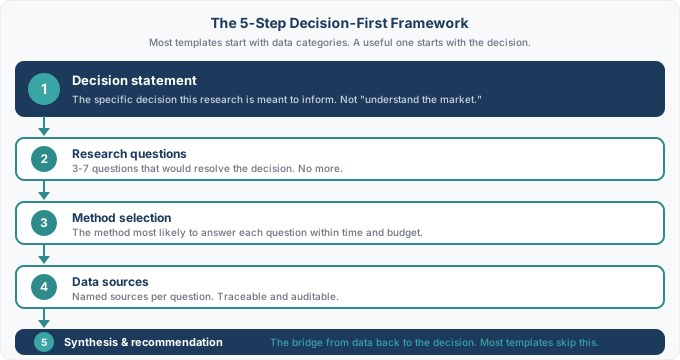
The framework below is the one we use on every $497 Standard Dossier engagement. It has five steps, and each step builds on the previous one. Skipping any of them produces a report that feels comprehensive and is strategically useless.
Step 1: Decision statement. Write down the specific decision the research is meant to inform. Not "understand the market" but "should we launch this product in Q3 at a $49 price point, or delay six months to reposition?" The more concrete, the better. A vague decision produces vague research. Every executive request for market research can be translated into a concrete decision if you ask twice. Founders want to know whether to pivot, enter a vertical, or raise a round. Product managers want to know whether to ship, kill, or rebuild. Investors want to know whether the thesis holds.
Step 2: Research questions. Identify the three to seven questions that, if answered with reasonable confidence, would resolve the decision. Not twenty questions. Three to seven. The discipline of limiting the question list is what separates a focused research effort from a boil-the-ocean data dump. If the decision is about a Q3 launch, the questions might be: Is there demonstrated demand at the $49 price point? Who are the three closest competitors and what do they charge? Are there regulatory or distribution blockers? Questions that do not connect back to the decision get cut.
Step 3: Method selection. For each research question, choose the method most likely to answer it within the time and budget available. A question about pricing sensitivity probably needs a survey or pricing interviews. A question about competitor strategy probably needs desk research, expert calls, or a competitive teardown. A question about regulatory risk needs legal research. The right method is the one that resolves the specific question, not the one you are most comfortable running.
Step 4: Data sources. For each method, name the specific sources you will use. Not "industry reports" but "Gartner 2025 Market Guide for X, Statista consumer survey, ten expert interviews with category buyers." Named sources force a level of specificity that vague templates avoid, and they make your findings auditable later. A reviewer should be able to look at the template and see exactly where every claim came from.
Step 5: Synthesis and recommendation. The bridge from data back to the decision. For each research question, write the two-to-three sentence answer the data supports. Then write a one-paragraph recommendation that directly answers the decision statement from Step 1. Most market research templates skip this step entirely. The research is presented as neutral findings and the reader is left to connect the dots. A useful template does the connecting.
This five-step structure is the tracking framework our team uses on every $497 Standard Dossier engagement. We are releasing the template free so any founder, product team, or fractional executive can work from the same structure.
Market research methods: the tradeoffs
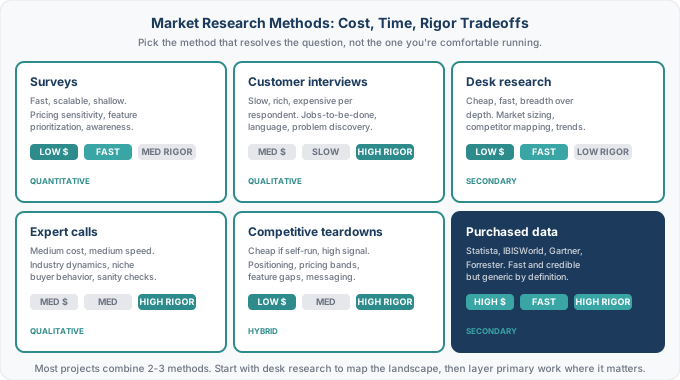
Method selection (Step 3 of the framework) is where most market research templates fall apart. They list every possible research method and leave the reader to pick. A useful template frames the choice as a set of explicit tradeoffs between cost, time, rigor, and fit for the research question.
The broadest split is between primary market research (data you collect yourself from original sources) and secondary market research (data someone else already collected and published). Secondary research is faster and cheaper. Primary research is more expensive and slower but produces data specific to your decision that no competitor has. Most well-run projects start with secondary research to map the landscape, then use primary research to validate assumptions and fill gaps the secondary research cannot close. Starting with primary research before secondary is a common mistake because it wastes time collecting data that already exists in published form.
Qualitative vs quantitative market research techniques
Inside primary research, methods split again between qualitative and quantitative. Qualitative market research (interviews, focus groups, ethnography) produces depth at the expense of statistical confidence. It is best for questions about why customers behave the way they do, what language they use to describe a problem, and what unmet needs they feel acutely. Quantitative market research (surveys, conjoint analysis, A/B tests) produces statistical confidence at the expense of depth. It is best for questions about how many, how often, and how much. The two are complementary. A strong research design uses qualitative work to generate hypotheses and quantitative work to test them.
Common market research techniques worth mentioning by name:
- Surveys. Fast, scalable, cheap per respondent, but limited in depth. Good for pricing sensitivity, feature prioritization, awareness metrics. We find a market research survey template of around 15-25 questions hits the sweet spot between coverage and completion rate, though the right length depends on incentive structure and audience.
- Customer interviews. Slow, expensive per respondent, rich in insight. Good for problem discovery, jobs-to-be-done analysis, and language your marketing team will actually use.
- Desk research. Free to cheap, fast, breadth over depth. Good for market sizing, competitor mapping, regulatory scans, trend reporting.
- Expert calls. Medium cost, medium speed. Good for industry dynamics, buyer behavior in niche markets, and sanity-checking conclusions from other methods.
- Competitive teardowns. Cheap if you do them yourself, time-consuming but high signal. Our competitor analysis template covers the full methodology.
- Purchased data. Statista, IBISWorld, Gartner, Forrester, industry trade associations. Fast and credible but generic by definition. Best for establishing baseline market context.
Market research questions a decision-first template must answer
Because every decision generates its own research questions, there is no universal list. What a good market research template does is force you to generate your own question list from Step 1 of the framework. That said, several categories of market research questions show up in almost every project, and you can use them as a starting checklist.
- Demand questions. Is there real demand for this offering at this price point? How much, how often, and among whom?
- Segmentation questions. Who are the specific customer segments that would buy, and how are they different from the segments that would not?
- Competitive questions. Who already serves this need, what do they charge, and where are they weak?
- Distribution questions. How do target customers currently discover and buy products in this category?
- Regulatory and risk questions. What external forces (legal, political, technological) could kill the opportunity?
- Willingness-to-pay questions. What is the ceiling on what this segment will pay? How elastic is demand above and below the proposed price?
Pick the four or five categories relevant to your decision and build two to three specific market research questions under each. That is your question list for Step 2 of the framework.
Types of market research mapped to decision types
The types of market research most templates list (exploratory, descriptive, causal, branding, product, pricing, distribution) are really just labels for the underlying decision. Here is the mapping that matters:
| Decision | Type of research | Primary methods |
|---|---|---|
| Launch yes/no | Concept testing, demand validation | Surveys, interviews, concept tests |
| Pricing and packaging | Willingness-to-pay, conjoint analysis | Surveys, Van Westendorp price sensitivity |
| Market entry (new geography or vertical) | Market sizing, competitive landscape, regulatory scan | Desk research, expert calls, purchased data |
| Positioning and messaging | Segmentation, jobs-to-be-done, language research | Qualitative interviews, ethnography |
| Product feature prioritization | MaxDiff, Kano analysis, usability research | Surveys, prototype testing |
| Investment thesis validation | Market sizing, trend analysis, commercial due diligence | Desk research, expert calls, financial modeling |
Most templates force you to pick a "type" of research up front. The decision-first framework inverts that. You pick the decision first, and the type of research falls out of Steps 1 and 2.
Real example 1: SaaS vertical expansion
A B2B SaaS company selling scheduling software to independent medical practices is considering expanding into veterinary clinics. The founder wants to know whether to commit engineering resources to the expansion or stay focused on the core market.
Filling in the decision-first template looks like this.
Decision statement: Should we launch a veterinary-specific version of our scheduling product in Q4, or delay the expansion until the core medical business reaches $5M ARR?
Research questions: (1) How large is the US veterinary scheduling software market and what is its growth rate? (2) Who are the incumbent players and what do they charge? (3) What are the three most painful scheduling problems for independent veterinary clinics today? (4) Are there category-specific requirements (compliance, integrations, workflows) that would require material product changes? (5) Would existing medical customers refer us into the veterinary market?
Methods: Desk research for market sizing and competitor mapping, ten veterinary practice manager interviews for pain points and willingness-to-pay, five expert calls with veterinary consultants for category dynamics, competitive teardown of the three largest incumbents.
Data sources: IBISWorld veterinary services report, AVMA industry statistics, G2 and Capterra competitor pages, ten recruited interviews via a market research platform, trade association directories for expert identification.
Synthesis: Market is 40% the size of medical scheduling but growing faster. Two incumbents dominate with pricing 20-30% below the medical market. Integration requirements are material but not prohibitive. Medical customers have few natural referral paths. Recommendation: delay the veterinary expansion by six months, hit $5M ARR first (a common benchmark for stable product-market fit in B2B SaaS), then revisit with more capital for a dedicated product team.
Notice what the template produced. A clear recommendation, grounded in specific data, traceable to named sources. That is what good market research looks like in practice.
Real example 2: CPG product line extension
A direct-to-consumer skincare brand is deciding whether to extend its bestselling moisturizer into a men's line. Marketing wants the launch. Operations is skeptical about the ROI on a second SKU.
Decision statement: Should we launch a men's version of our bestselling moisturizer in Q2, and at what price point?
Research questions: (1) How large is the men's skincare category and is it growing? (2) What do existing buyers of our women's moisturizer say when asked about the men in their household? (3) What price points do men in our target demographic actually pay for skincare, and how is that changing? (4) What are the three strongest competitor products we would face on Amazon and Sephora?
Methods: Desk research for category sizing, a 500-respondent quantitative survey of current customers and lookalikes for willingness-to-pay, competitive teardowns of the three strongest incumbents, social listening for category language and trends.
Data sources: Statista men's grooming category data, NielsenIQ retail scans, 500-respondent survey via a market research panel, Amazon review scraping for competitive positioning, TikTok and Reddit social listening for category conversation.
Synthesis: Category is growing 8% annually and men's skincare spend has shifted upmarket, with median buyer paying 30% more than three years ago. Current customers report that the men in their households already use the women's product, which suggests latent demand. Willingness-to-pay data supports a $38-48 price band. Three competitors cluster at $35-42 with heavy positioning around "routine simplicity." Recommendation: launch at $42 with routine-simplicity positioning, target existing customer households for initial distribution, expect the first year to return 60-70% of the gross margin of the core product.
Same framework, different decision, different methods, different data sources. The structure does not change.
The end-to-end market research process (the 6 phases around the framework)
The 5-step framework lives inside a broader workflow that runs end to end from executive request to final deliverable. Think of it as two levels: the 5-step template framework is what you fill in, and the 6-phase process below is how the work actually moves through your team. The template framework is a subset of phases 1 through 5.
- Frame the decision. Translate the executive request into a concrete decision statement. This is the same work as Step 1 of the template framework, just viewed from the project-management level.
- Define questions and hypotheses. Generate the 3-7 research questions and write down what you expect the answer to be before you start collecting data. Pre-registering your hypothesis reduces confirmation bias.
- Design the research. Select methods, choose data sources, size the sample, draft the survey or interview guide. This is where a market research plan template or market research proposal template gets written if you are selling the work to a stakeholder.
- Collect the data. Run the surveys, conduct the interviews, pull the desk research, commission the panels. Track progress against the template's question list so nothing gets dropped.
- Analyze and synthesize. Code the qualitative data, run the quantitative analysis, write the two-to-three sentence answer for each research question, and build the recommendation.
- Deliver and debrief. Present the synthesis, defend the recommendation, and capture follow-up questions for the next round. A market research report template makes the delivery step repeatable and consistent.
The 6-phase process above is not a new framework. It is the standard workflow used by almost every research firm and in-house insights team. What the decision-first template does is make Phase 1 (frame the decision) non-optional and carry it through all the others.
Common market research mistakes
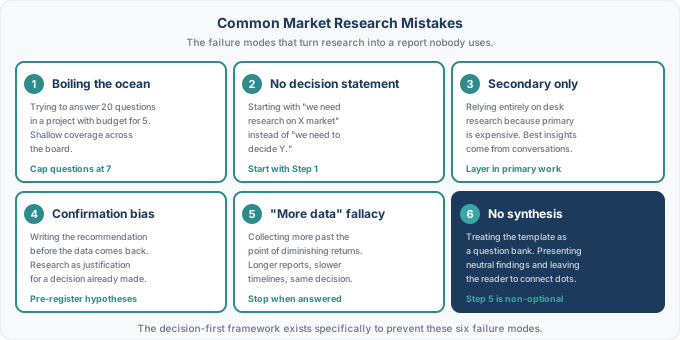
A handful of failure modes show up in almost every project that produces a report instead of a decision. A good template helps you avoid them.
Boiling the ocean. Trying to answer twenty research questions in a project that has budget for five. The result is shallow coverage across the board and a report that answers nothing decisively. The five-step framework caps the question list at seven for this reason.
Skipping the decision statement. Starting with "we need market research on X market" instead of "we need to decide Y." The research that follows is unfocused, the report reads like a Wikipedia entry, and the reader still has to figure out what to do with it.
Secondary-only research. Relying entirely on published reports and desk research because primary research is expensive. Secondary research is the right way to start, but any decision with real money behind it should include at least some primary validation. The most important insights usually come from direct customer conversations, not from a Statista chart.
Confirmation bias traps. Writing the recommendation before the data comes back. Executives sometimes ask for market research to justify a decision they have already made. A decision-first template makes this harder because Step 5 forces you to write a synthesis that is traceable to the data from Step 4.
The "more data is better" fallacy. Collecting more data does not produce better decisions past a certain point. It produces longer reports and slower timelines. A good template forces ruthless prioritization on the front end so the research stops when the decision is answered.
Treating the template as a question bank. Filling in every section with generic data instead of data that answers the specific question. This is the failure mode that makes market research feel like a checkbox exercise. The decision-first structure prevents it because every section has to trace back to the decision statement.
The statistics on product failure rates illustrate the cost of getting this wrong. The late Harvard Business School professor Clayton Christensen, author of The Innovator's Dilemma, is widely credited with the observation that roughly 95% of the 30,000 new consumer products launched each year fail commercially — a figure that has become a standard reference in HBS case research and innovation literature. CB Insights analysis of startup post-mortems has repeatedly found that "no market need" is the single largest cause of startup failure, cited in 35-42% of shutdowns across its multi-year studies. The Product Development and Management Association's benchmarking work has found that only 61% of new products meet their business goals, and that it takes close to nine ideas to produce one commercial success. Most of those failures are not product quality failures. They are research failures. The team did not answer the right questions before building.
Market research tools and platforms
For teams running their own research, a handful of platforms cover most of the work.
| Tool | Strength | Best for | Pricing |
|---|---|---|---|
| SurveyMonkey | General-purpose surveys, wide template library, easy distribution | Small-to-mid survey work, concept testing | $25-100+/month |
| Qualtrics | Advanced methodology (conjoint, MaxDiff, Van Westendorp), enterprise-grade | Pricing research, academic-quality studies | Enterprise custom |
| Statista | Pre-aggregated industry data and consumer statistics across 170+ industries | Desk research, market sizing, trend charts | $39-199/month |
| SimilarWeb | Competitor traffic, engagement, and audience data | Digital competitive teardowns | $199+/month |
| Our template | Decision-first 5-step structure, free, works in Google Sheets or Excel | Teams of any size running their own research | Free download below |
No tool replaces the framework. The best survey platform in the world cannot fix a project that started without a decision statement. Pick the tool after you have filled in Steps 1 and 2 of the template, not before.
How long market research actually takes
Timeline depends on the decision and the methods. A tightly scoped decision that can be answered with desk research alone runs one to two weeks. A decision that requires primary quantitative research (500-respondent survey plus analysis) runs three to five weeks. A decision that requires qualitative interviews runs four to eight weeks because recruitment and scheduling are slow. Full commercial due diligence for a market entry or acquisition decision runs six to twelve weeks when done properly.
The time cost is the biggest reason teams outsource market research. Hiring an outside researcher rarely saves money against doing it yourself, but it consistently saves weeks of calendar time and frees internal bandwidth for the decision itself.
Download the Market Research Template
The template includes the full 5-step decision-first framework, a methods selection worksheet, a primary vs secondary research matrix, a question generation worksheet, and a synthesis template with worked examples.
Free Market Research Template
Google Sheets and Excel format. Decision-first framework, method selection worksheet, data source tracker, synthesis template with two worked examples.
- 5-step decision-first framework
- Method selection matrix
- Question generation worksheet
- Two worked examples (SaaS + CPG)
Frequently asked questions
What is the difference between a market research template and a market research plan?
A market research plan template is the upfront strategy document describing what you will research, why, how, and when. It is written before the work starts and is usually one to three pages. A market research template is the working document you fill in during the research itself, organized by decision logic rather than by plan section. Both exist on the same project: you write the plan, then use the template to do the work.
How long should market research take?
Tightly scoped decisions answered with desk research alone take one to two weeks. Decisions requiring primary quantitative research take three to five weeks. Decisions requiring qualitative interviews take four to eight weeks because recruitment is slow. Full commercial due diligence takes six to twelve weeks. Budget according to decision complexity, not default timelines.
Should I start with primary or secondary research for a new market entry?
Start with secondary research to map the landscape, then use primary research to validate assumptions and fill specific gaps. Starting with primary research before secondary wastes time collecting data that already exists in published form. The exact mix varies by decision type, but secondary research should come first and primary should fill the gaps secondary cannot close.
When should I do market research myself vs hire a researcher?
Do it yourself when the decision has small stakes, tight timeline, and you know the category well. Hire it out when the stakes are material (six figures or more), when you need outside objectivity to counter internal bias, when the methodology requires specialized capabilities you do not have in-house (conjoint analysis, large-scale survey work, expert networks), or when leadership needs a credible third-party voice to align the team around a decision.