Most TAM SAM SOM templates you find online are three stacked circles and a placeholder percentage. Total addressable market at the top, serviceable addressable market in the middle, serviceable obtainable market at the bottom, and "we will capture 1% of the market" as the conclusion. That is not a template. It is a pitch-deck slide, and it is the exact thing experienced investors have been trained to ignore.
A useful TAM SAM SOM template does something different. It forces you to calculate the total addressable market two ways, once from the top down using published sources and once from the bottom up using unit economics, and reconcile the delta before the number goes in front of anyone. This guide covers what a TAM SAM SOM template actually is, the triangulation method at the center of the framework, the 5-input method for bottom up market sizing, two real worked examples (a B2B SaaS vertical and a DTC consumer brand), what investors actually look for, and the common mistakes that kill credibility. The template is free at the bottom of the page.
If you want to learn how to evaluate someone else's market sizing work rather than build your own, our companion guide on how to read a TAM SAM SOM analysis covers the reader side of the same framework.
What is total addressable market (and why TAM alone is not enough)
Total addressable market is the total annual revenue opportunity for a product or service if it captured 100% of its category. It is the biggest number in any market sizing analysis, and the one investors trust the least when it appears alone. A $50 billion TAM with no supporting logic is worse than a $500 million TAM with a clear path to capture.
Three layers sit underneath TAM. Serviceable addressable market (SAM) is the slice of TAM you can actually reach given your geography, channel, and buyer type. Serviceable obtainable market (SOM) is the slice of SAM you can realistically capture given your sales capacity, competitive density, and go-to-market constraints over a defined time horizon. A fourth acronym shows up in some modern decks: potential addressable market (PAM) extends TAM forward to include demand that does not exist yet but could emerge if the product creates a new category. Uber's 2008 seed pitch deck calculated TAM against the existing US taxi and limo market of roughly $4 to $5 billion, but the actual PAM turned out to be the entire global personal transportation market, estimated in subsequent industry analyses in the decade after the raise at over $80 billion. Most market sizing work ignores PAM because it is speculative. The better analyses at least name the assumption so the reader knows whether they are looking at current or future demand. If your product creates a new category, add PAM as a footnote to the template rather than leaving it out entirely.
A TAM SAM SOM template is the structured worksheet you use to build all three (or four) numbers in the same place, with named sources, explicit assumptions, and a reconciliation step. It is not a slide. A slide is the output. The template is the work behind the slide.
How to size a market: the triangulation method
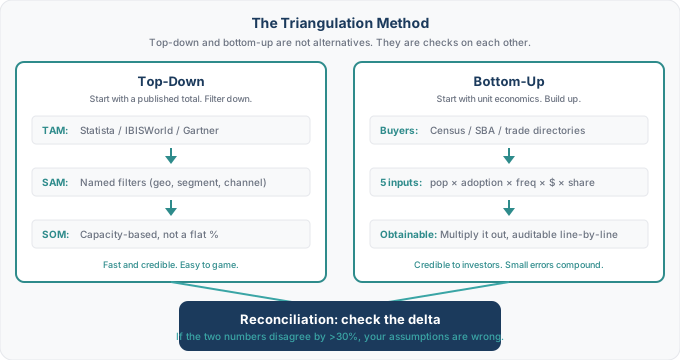
The triangulation method is the single most important idea in this template. Top-down and bottom-up are not alternatives. They are checks on each other. A credible market sizing analysis produces both numbers in the same sheet and explains the delta.
Top-down market sizing starts with a published industry total (Statista, IBISWorld, Gartner, Forrester, a government statistical agency, a trade association report) and applies named filters to narrow from TAM to SAM to SOM. Its advantage is speed and credibility of source. Its weakness is that it is easy to cobble together a big number from pre-packaged categories without actually understanding what is inside them. Investors have seen this trick enough times to spot it in seconds.
Bottom up market sizing starts with the unit economics of your business (number of buyers, price per buyer, purchase frequency, attainable share) and builds up to a total. Its advantage is that every input is traceable to a specific assumption about how the market actually behaves. Its weakness is that each assumption is easy to inflate on the way up, and small input errors compound into large output errors.
Running both in parallel catches errors neither method finds on its own. If your top-down TAM comes in at $2 billion and your bottom-up TAM comes in at $500 million, something is wrong. Either the top-down source includes categories you should not count, or your bottom-up assumptions are too narrow, or both. The useful work happens in the reconciliation, not the calculation. A template that only forces you to do one method has failed the job.
Our rule of thumb: if top-down and bottom-up disagree by more than 30%, stop and find the error before the number goes anywhere. If they disagree by less than 30%, present the lower number as your defensible TAM and explain the delta in a footnote.
Top-down market sizing: how to do it without hand-waving
Top-down calculation is where most market sizing work starts. Done well, it gives you a credible ceiling. Done badly, it is a collage of unrelated statistics that does not answer anything.
Step one: find a trusted industry total for the broadest version of your market. Statista, IBISWorld, Gartner, Forrester, and government sources (Census Bureau, Bureau of Labor Statistics, trade department statistics, industry association annual reports) are the default options. Name the source, name the year, name the geographic scope. A 2019 global number used in a 2026 analysis is stale. A North America number presented as global is misleading.
Step two: apply named filters to get from TAM to SAM. Each filter must have an explicit justification. "Filter to firms with 50-500 employees because our product does not serve sole proprietors or enterprises" is defensible. "Filter to 10% because we are focusing on the top decile" is not, because 10% of what and on what criteria? SAM filtering is usually done on geography, buyer type, industry vertical, or distribution channel. Each filter cuts the number and must survive a sanity-check question.
Step three: apply named constraints to get from SAM to SOM. This is where the SAM/SOM collapse problem shows up, and most templates get lazy here. A credible SOM is built from realistic sales capacity, not a flat percentage. How many buyers can your sales team actually close in year one? How many of those will you actually reach given your marketing budget and channel strategy? What will competitors take? The answer is almost always a much smaller number than the instinct to write "we will get 10% of SAM" would suggest.
Bottom up market sizing: the 5-input method
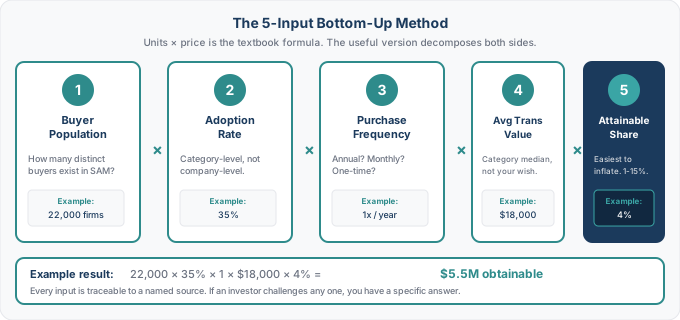
The textbook bottom-up formula is units × price. That is correct and useless. It gives you two variables to guess at instead of the dozen you actually need to reason about. The decomposition that works splits those two variables into five named inputs, each with its own source and sanity-check range.
Input 1: Buyer population. How many distinct buyers exist in your SAM? Not "small businesses" but "independent medical practices with 2-10 providers in the United States" and a specific count from a named source (AMA directory, SBA data, Crunchbase, LinkedIn Sales Navigator, trade association registries). This is the foundation number and the one most people guess at.
Input 2: Adoption rate. Of that buyer population, what percentage will adopt a product like yours? This is a category-level question, not a company-level one. If you are building scheduling software for medical practices, what percentage of medical practices currently use any scheduling software at all? Published industry adoption rates (SaaS penetration reports, Gartner adoption curves, category-specific research) are the right source. The number is usually lower than you think.
Input 3: Purchase frequency. How often does a buyer in this category buy? For SaaS it is an annual subscription. For consumer goods it might be monthly, quarterly, or one-time. For B2B services it might be once every three years. Multiplying buyers by annual value without checking the purchase cycle inflates the number.
Input 4: Average transaction value. What does a typical transaction look like in this category today? Not what you wish it looked like. Use competitor pricing as the reference, or published category benchmarks from industry reports. If your price is higher than the category median, you need to either justify the premium or size at the median and call out the premium as upside.
Input 5: Attainable share. Of that total, what share can your specific business realistically capture? This is the most fraught input because it is the easiest to inflate. Default to conservative benchmarks: 1-3% for a new entrant in a crowded category, 5-10% for a differentiated product with an unfair advantage, 15%+ only if you have evidence of dominant positioning. Anything above 15% without supporting evidence should be flagged as speculative.
Multiply the five inputs together and you have a bottom-up TAM you can defend line by line. A concrete example: 700,000 target firms × 40% category adoption × 12 monthly purchases × $99 per month × 10% attainable share = $33 million obtainable revenue. Every input is auditable, and if an investor challenges any one of them, you have a specific source and a named assumption to discuss.
This is the bottom up market sizing framework our team uses on every $497 Standard Dossier engagement. We are releasing the template free so any founder can run the same calculation before their next board meeting or fundraise.
The SAM/SOM collapse problem
This is the failure mode that separates a credible template from a pitch-deck slide. Most templates build TAM carefully from a named source, then collapse SAM and SOM into single percentages without supporting logic. "SAM = 20% of TAM because North America. SOM = 1% of SAM because we are early." The reader has no idea whether those percentages are defensible, and an experienced investor will ask questions the founder cannot answer.
The fix is explicit filtering logic at both layers. SAM filtering should be a list of named cuts, each with a justification: geography ("US only, because international localization adds 18 months"), buyer type ("50-500 employee firms, because sole proprietors do not have budget and enterprises require a 9-month sales cycle"), channel ("direct sales only, because our partner channel is not built yet"). Each cut is a row on the template and removes a specific slice of the TAM.
SOM should be built from capacity, not percentage. How many accounts can your sales team close in year one given your hiring plan, sales cycle length, and close rate? If you have 3 AEs and each can close 2 deals per month and a deal is worth $20,000 ARR, your year-one SOM is $1.44 million regardless of what percentage that represents. That is a defensible number. "We will get 1% of the $500M SAM" is not.
Real example 1: B2B SaaS vertical market sizing
A cybersecurity startup is sizing the market for a phishing detection product aimed at mid-market manufacturing firms in the United States. The founder needs a TAM slide for a Series A pitch. The numbers below are illustrative to show the template structure, not sourced market estimates.
Top-down: Starting with a published US cybersecurity software market size (the real-world source would be a current Gartner, IDC, or Forrester market forecast, cited by title and year), the founder filters to the email security sub-segment (~10%) = $8 billion. Filter further to mid-market buyers by employee count (~15%) = $1.2 billion TAM. SAM filter to US-only mid-market manufacturing (~8% of mid-market) = $96 million SAM. SOM at 5% (early-stage defensible attainable share) = $4.8 million.
Bottom-up: Buyer population = 22,000 US manufacturing firms with 500-2,500 employees (the real-world source would be the Census Bureau's Statistics of US Businesses). Adoption rate for dedicated email security tools in this segment = 35% (the real-world source would be a named SaaS penetration study or industry association survey). Purchase frequency = annual subscription. Average transaction value = $18,000 per year (sourced from three named competitor price points). Attainable share = 4% (conservative for a new entrant). 22,000 × 35% × $18,000 × 4% = $5.5 million obtainable.
Reconciliation: Top-down SOM $4.8M, bottom-up obtainable $5.5M. Delta of 13%, well within the 30% rule of thumb. The founder uses the lower number ($4.8M year-one obtainable) in the Series A deck and explains the triangulation in the appendix.
Notice what the template produced. Two independent calculations that arrived at close to the same number using different data sources. That is what triangulated market sizing looks like in practice, and it is what experienced investors will nod at instead of push back on.
Real example 2: DTC consumer brand sizing
A direct-to-consumer men's skincare brand is sizing the opportunity for a premium moisturizer line in the US market for a seed round. As with the first example, the numbers are illustrative to show the template mechanics, not live market estimates.
Top-down: US men's grooming category total (real-world source would be a currently-dated Statista or NPD category report, cited by title and year). Assume a $17 billion category baseline. Filter to skincare sub-category (~22%) = $3.7 billion. Filter to premium DTC (~15% of skincare, based on category research) = $555 million SAM. SOM at 2% (consistent with emerging DTC brand benchmarks) = $11 million.
Bottom-up: Buyer population = 7.8 million US men aged 25-44 in top two income quintiles (the real-world source would be the Census Bureau American Community Survey). Adoption rate for premium skincare = 18% (the real-world source would be a named and currently-dated consumer grooming study). Purchase frequency = 4 units per year at steady state. Average transaction value = $38 per unit (sourced from three named competitor SKUs). Attainable share = 1.5% (conservative for an emerging brand). 7.8M × 18% × 4 × $38 × 1.5% = $3.2 million obtainable.
Reconciliation: Top-down SOM $11M, bottom-up obtainable $3.2M. Delta of 71%, well outside the 30% rule of thumb. This is a warning sign, not a problem. The founder investigates and finds the issue: the top-down 15% premium DTC filter is too optimistic because it includes all premium skincare, not just DTC-first brands. Refiling to 6% (the DTC-native share per the same research) drops the top-down SAM to $222M and SOM to $4.4M. The bottom-up and top-down now agree within 38%, still above the rule of thumb but close enough to present with a clear explanation of which filter was tightened and why.
Same framework, different industry, different inputs, different failure mode caught by the reconciliation step. That is the value of triangulation.
Common market sizing mistakes
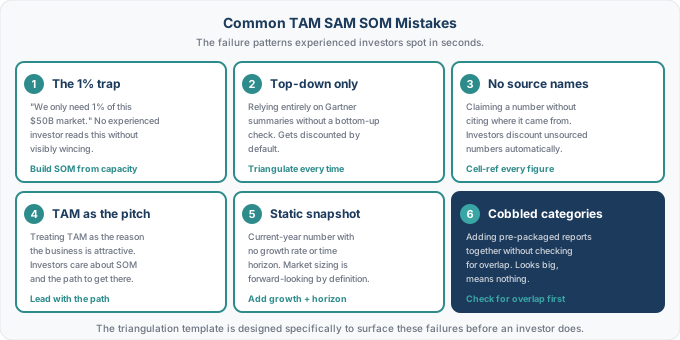
A handful of failure patterns show up in almost every market sizing deck that gets pushed back on.
The 1% trap. "We only need to capture 1% of this $50 billion market to be a $500 million business." No experienced investor has ever read this sentence without visibly wincing. The 1% trap treats capture as a dartboard throw rather than a function of sales capacity, competitive dynamics, and go-to-market realism. A $5 million obtainable number built from named inputs is worth more than a $500 million number built from hand-waving.
Top-down only. Relying entirely on published industry totals without a bottom-up check. Investors have been burned enough times on cobbled-together Gartner summaries that top-down-alone numbers get discounted automatically. A single bottom-up calculation, even a rough one, raises the credibility of a top-down number by an order of magnitude because it shows you understand what sits underneath the published total.
No source names. Claiming a TAM of $X without naming where $X came from. Every number in a defensible template has a cell reference to a named source: publication, year, geographic scope, and what the source measured. If the source is "internal estimate," that is also fine as long as it is labeled as such and the assumption is traceable.
TAM as the pitch. Treating the TAM number as the reason the business is attractive. It is not. The TAM number is a ceiling check. It answers the question "is this big enough to matter if we win" and nothing else. Investors care far more about SOM and the path from today to SOM than they do about TAM. A common VC observation: a smaller TAM with a clear path to capture beats a bigger TAM with no path every time.
Static snapshots. Presenting TAM as a single current-year number with no growth rate or time horizon. TAM SAM SOM is a forward-looking framework by definition. The useful template includes a growth rate assumption (sourced from the same industry research as the TAM base) and a three-to-five year forward projection that lets the reader see whether the market is expanding, contracting, or stable.
Cobbled categories. Adding together pre-packaged categories from different research reports without checking for overlap. "The market for our product is the sum of the CRM market + the marketing automation market + the customer data platform market" produces a number that looks big and is meaningless because those categories overlap by 20-40% depending on the source. Always check for overlap before adding.
What investors actually look for in a TAM SAM SOM slide
Based on published guidance from Antler, Pear VC, TechCrunch's pitch-deck coverage, and the reviewed commentary of multiple early-stage VCs, the criteria experienced investors use to evaluate a TAM SAM SOM slide are consistent.
Bottom-up preferred. Investors consistently prefer bottom-up numbers because they reveal how the founder thinks about unit economics and go-to-market. Top-down numbers tell an investor that the founder can cite Gartner. Bottom-up numbers tell an investor that the founder understands the business.
Named sources. Every number on the slide should be traceable to a source the reader can check. Unsourced numbers get discounted.
A realistic SOM. The number that matters most on the TAM SAM SOM slide is actually SOM, because SOM answers the question "can this company hit the $100M ARR that justifies the Series A valuation." A TAM SAM SOM slide with a credible SOM beats one with a bigger TAM and a hand-waved SOM.
A growth rate and time horizon. Market sizing without a time component is incomplete. The slide should name the year the TAM was measured, the growth rate, and the projected SAM/SOM three to five years out.
A $1 billion floor for venture-scale opportunities. For a venture-backed company targeting a Series A and beyond, the consensus benchmark is that TAM should clear $1 billion. Below that, the math for a venture return does not work unless there is a credible path to category expansion (PAM). Some VCs will fund smaller TAMs if the SOM is strong and the path is clear, but $1 billion is the widely-cited minimum for most enterprise software funds.
Market sizing tools and templates
Several tools cover part of the market sizing workflow. None of them replace the triangulation framework.
| Tool | Strength | Best for | Pricing |
|---|---|---|---|
| Statista | Pre-aggregated industry data across 170+ categories, fast top-down source | Top-down TAM baselines | $39-199/month |
| IBISWorld | Detailed industry reports with historical data and forward projections | Industry structure and growth rates | Enterprise custom |
| Scalepath | B2B SaaS market sizing platform with bottom-up calculators | B2B SaaS Series A-D founders | Custom pricing |
| Miro market sizing template | Visual collaborative template for workshops | Team-based sizing exercises | Free (with Miro) |
| Our template | Triangulation method, 5-input bottom-up worksheet, SOM capacity model, two worked examples | Founders raising capital, fractional CFOs, deal teams | Free download below |
No tool replaces the framework. Statista can give you a fast top-down number, but it cannot tell you whether your bottom-up agrees with it or whether your SOM is defensible. The thinking is the hard part. The tools are the easy part.
How long market sizing actually takes
Timeline depends on the decision. A quick-and-dirty sizing for a founder's first pitch runs one to two days if the founder already knows the category and has access to named sources. A defensible sizing for a board meeting or Series A runs one to two weeks, because the reconciliation between top-down and bottom-up takes real work. A rigorous market sizing for an institutional investment decision runs three to six weeks and includes expert calls, competitive teardowns, and independent validation of the bottom-up inputs.
Most founders should budget for the one-to-two week version. A one-day TAM slide is almost certainly wrong somewhere, and the wrongness tends to surface in the Q&A portion of the pitch at the worst possible moment.
Download the TAM SAM SOM Template
The template includes the triangulation worksheet, top-down filter tracker, 5-input bottom-up calculator, SOM capacity model, a reconciliation delta check, and two worked examples (the B2B SaaS and DTC consumer examples from this article, filled in).
Free TAM SAM SOM Template
Google Sheets and Excel format. Triangulation worksheet, top-down filter tracker, 5-input bottom-up calculator, SOM capacity model, and two worked examples.
- Triangulation worksheet with delta check
- 5-input bottom-up calculator
- Capacity-based SOM model
- Two worked examples (B2B SaaS + DTC)
Frequently asked questions
What is the difference between TAM and market size?
TAM (total addressable market) is a specific kind of market size number: the revenue a business would capture if it served 100% of its category. "Market size" is a broader term that can refer to TAM, SAM, SOM, unit volume, customer count, or any other measure of a market's scale. When investors ask for "market size," they almost always mean TAM plus SAM plus SOM presented together with a credible path from one to the next.
Should I start with top-down or bottom-up market sizing?
Start with top-down to establish a ceiling from a credible published source. Then run bottom-up independently and compare. If the two numbers disagree by more than 30%, figure out which assumption is wrong before presenting either. Investors consistently prefer bottom-up because it shows you understand the unit economics, but top-down is the source of credibility for your ceiling claim. Do both.
What makes a SOM credible?
A SOM built from sales capacity, not from a flat percentage of SAM. Answer the question "how many accounts can our sales team actually close in year one" by multiplying sales reps × monthly quota × deal size. That produces a defensible number traceable to your hiring plan and sales cycle. A SOM like "we will capture 1% of the market" is the single biggest red flag in any pitch deck.
When should I use TAM SAM SOM versus a different framework?
TAM SAM SOM is the default for venture-backed startups pitching investors because it matches how VC investment memos are structured. Alternatives include bottom-up only (for founders who know their category deeply and want to avoid top-down inflation), TAM + PAM (for founders creating a new category where the existing market understates the opportunity), or revenue forecasting (for later-stage companies where the question is execution capacity, not market size). For any pre-Series B company raising from traditional venture, TAM SAM SOM is table stakes.