Most articles on AI market research land in one of two camps. The breathless camp claims AI will replace research analysts within two years. The skeptical camp insists AI is useless because it hallucinates. Both are wrong, and both produce bad advice if you’re trying to make market research for business decisions actually work.
AI genuinely accelerates three parts of the research process. It actively degrades three others. The difference between an AI-assisted workflow that produces a defensible deliverable and one that burns your credibility in front of a board is knowing which is which.
What follows covers both: what AI does well in research (desk work, first-pass synthesis, structured analysis), where it fails (source verification, strategic judgment, novel framing), the market research tools and platforms worth using, the methodology that keeps output defensible, and the common mistakes that turn AI-assisted research into confident garbage.
What AI market research actually is
The term “AI market research” gets stretched across three different things, and the distinction matters.
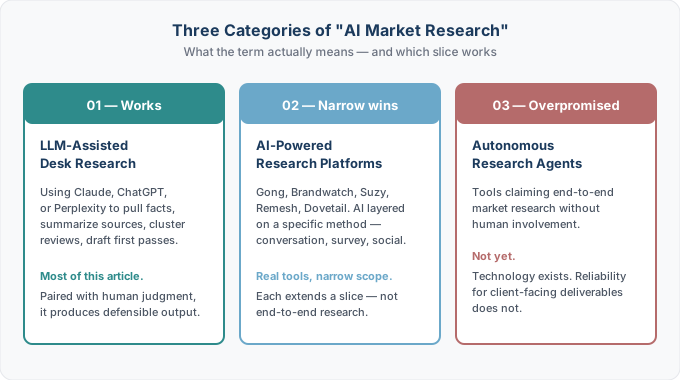
LLM-assisted desk research. Using Claude, ChatGPT, Perplexity, or similar tools to pull facts, summarize sources, cluster reviews, and draft first passes of analysis. This is what most people mean, and it’s the piece that actually works.
AI-powered market research platforms. Dedicated products like Gong, Brandwatch, Suzy, Remesh, and Dovetail that layer AI on top of a specific data collection method (conversation intelligence, social listening, survey panels, community research). These are real tools with real use cases, but they extend specific slices of research rather than replace the discipline. This is the same category competitive intelligence software sits in.
Autonomous research agents. Tools that claim to execute end-to-end market research without human involvement. File under “overpromised for now.” The technology exists. The reliability required to hand a final deliverable to a client without human review does not.
When this article talks about AI market research, it means the first category: LLM-assisted desk research paired with human judgment. That’s the discipline most operators are actually running in 2026, and it’s the one worth getting right.
Where market research for business actually changes with AI
The productivity lift shows up cleanly in a handful of places where AI-assisted research is strictly faster, cheaper, and usually just as good as what a junior analyst produces.
1. Desk research volume. Reading 40 competitor websites, 20 annual reports, and 100 Glassdoor reviews used to eat a full analyst day. A properly-prompted LLM (Perplexity Pro for source-cited fact-finding, Claude for long document analysis) compresses that to under an hour while producing structured output. The limitation isn’t the AI. It’s the quality of the source material and the specificity of the prompt.
This is where traditional market research methods get their biggest productivity boost. Secondary desk research, industry scan work, public-filing review, online review mining: all of it compresses by roughly 5-10x when AI handles the volume and a human handles the framing.
2. First-pass pattern recognition. Clustering 500 customer reviews into themes, summarizing open-ended survey responses, identifying recurring complaints across support tickets. This kind of unstructured text analysis is where LLMs genuinely shine. A mid-size qualitative research project that would have taken a researcher three days produces equivalent output in thirty minutes.
3. Structured synthesis from clean inputs. Feed an LLM structured data (a list of competitors, category definitions, scored attributes) and you get credible first drafts of SWOT analyses, competitive matrices, and market sizing inputs. The triangulation method for market sizing works well here: an LLM can generate both a top-down estimate from industry sources and a bottom-up estimate from unit economics, and flag the gap between the two. A human still has to verify both sources and interpret the delta. (We covered how to read the output in “How to Read a TAM/SAM/SOM Analysis Without an MBA”.)
Each of these follows the same pattern. AI handles volume and pattern-matching. Humans still handle scope, verification, and interpretation.
Where AI market research fails
The failure modes are specific, and each has a measurable cost.
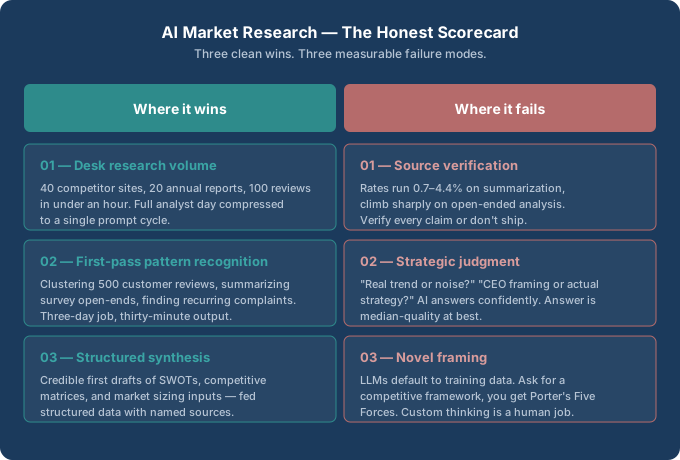
1. Source verification and hallucination. Hallucination rates in 2026 vary wildly by task. Current frontier models achieve rates of roughly 0.7–4.4% on constrained summarization benchmarks (Gemini 2.0 Flash, GPT-4.1, Claude 3.7 Sonnet). Rates climb sharply on open-ended analysis: an AIMultiple benchmark testing 37 models under adversarial prompting conditions measured rates between 15% and 52%. Task type is the biggest variable. In domains with less training data the numbers get dramatically worse, with medical summarization reaching 64.1% hallucination without mitigation. Market research sits in the middle of that spectrum, which means you can’t trust any fact an LLM surfaces unless you’ve verified it against the primary source.
2. Strategic judgment. AI is excellent at summarizing what happened. It’s poor at interpreting what it means. “Is this a real trend or statistical noise?” “Does this CEO’s earnings call framing reflect actual strategy or cover for a missed quarter?” “Does this emerging competitor have the distribution to matter or is this a feature release we can ignore?” These are the questions that make research useful, and they require someone who has watched an industry for years. An LLM will answer them confidently. The answer will usually be median-quality at best.
3. Novel framing. LLMs default to their training data. Ask for a competitive framework and you get Porter’s Five Forces, SWOT, or a Strategic Group Map: the frameworks that show up most in the training set. That’s useful when those frameworks fit the question, counterproductive when the research needs a custom mental model. For engagements where the value is recognizing that a category needs new framing, AI pulls you toward the median every time.
How AI changes what you pay a research consultant for
Three years ago, an outsourced research engagement at the productized end of the market cost $2K-$10K and took 2-4 weeks. The work was mostly desk research volume: reading, summarizing, organizing into a deliverable.
AI has collapsed that part of the work. A $497 productized research dossier in 2026 delivers what a $5K engagement delivered in 2023, with turnaround measured in days rather than weeks. The thing clients are actually paying for has shifted.
The value is no longer in research volume; LLMs handle that. The value is in:
- Scope and question framing. Deciding what to research in the first place, which is the 20% of the work that drives 80% of the output quality.
- Source discipline. Verifying every AI-surfaced claim against primary sources, maintaining attribution, catching hallucinations before they ship.
- Synthesis and judgment. Turning a pile of verified facts into a recommendation the reader can act on.
- Methodology. Using frameworks like the triangulation method, the weighted competitor matrix, or the canonical DD categories that withstand scrutiny from a skeptical board or investor.
If a market research consultant or research firm is selling you AI as the value prop, they don’t understand what they’re selling. The AI is the accelerant. The judgment is the product.
The same logic applies for specific audience segments. Market research for startups is now mostly about velocity and founder-decision fit, and AI shines here because the founder sits across the table and supplies the strategic judgment the AI lacks. Market research for small business with a tight budget is now accessible in a way that enterprise-tier engagements were not. Both benefit from the same discipline: AI-assisted gather, human-led interpret.
The AI market research tools worth using (and the ones that overclaim)
The market research tools and platforms landscape in 2026 sorts into five buckets that matter.
| Tool | Best for | Where it fails |
|---|---|---|
| Perplexity Pro | Source-cited research, Deep Research feature, fast fact-finding | Citations sometimes link to the wrong passage; still needs human verification |
| Claude (Sonnet / Opus, 4.x generation) | Long document analysis, structured synthesis, reasoning | No real-time web access in standard chat; knowledge cutoff matters |
| ChatGPT (GPT-5 generation) | Ideation, prompt refinement, first drafts, conversational exploration | Weakest on source attribution of the major tools |
| NotebookLM | Working with source documents you provide (uploaded PDFs, URLs) | Limited to documents you hand it, not open-web research |
| Specialized platforms (category representatives) | Extending a specific data collection method with an AI layer (see note below) | Each solves a narrow slice, not end-to-end research |
The specialized-platforms row lumps five different product categories into one line because they share a pattern, not because they’re interchangeable: Gong for conversation intelligence, Brandwatch for social listening, Suzy and Remesh for panel and community research, Dovetail for qualitative synthesis. Pick the one that matches the data source you’re already collecting.
The competitive intelligence tools category is converging with this list fast. Crayon, Kompyte, and Klue all ship AI-assisted feature tracking. The value isn’t the AI. It’s the structured data collection (consistent fields, named sources, timestamps) that AI alone can’t produce without a schema to fill.
Tools to be skeptical of: anything marketing itself as “autonomous market research” or end-to-end AI research agents. The category exists. The reliability required to put a research report in front of a client or board without human review does not.
When market research firms pitch “AI-powered” as the value prop, the AI is the accelerant. The process and the judgment are still the product.
How to use AI for market research without burning credibility
If you’re going to put an AI-assisted research product in front of a board, an investor, or a client, these are the market research steps that keep it defensible.
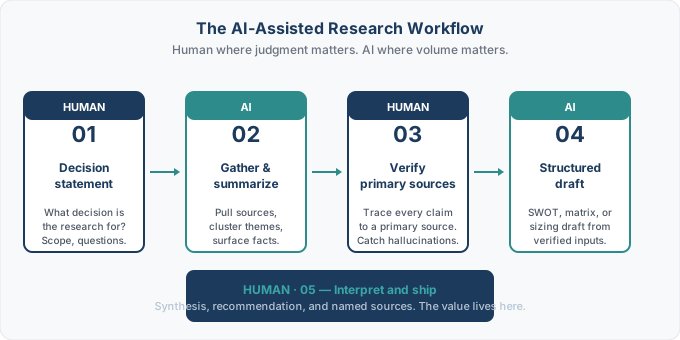
Start with a decision statement, not a keyword. Same discipline we cover in the market research template: write down the specific decision the research is meant to inform before you open Perplexity. “Should we launch this product in Q3 at a $49 price point?” produces focused research. “AI market research on pricing” produces a data dump.
AI does the gather pass. Humans do the interpret pass. Use AI to surface sources, summarize findings, and cluster data. Use humans to decide what matters, what contradicts, and what the recommendation is. Reverse the order and you get fluent nonsense.
Verify every fact against a primary source before it ships. If an AI tool surfaces a statistic (say, “the B2B SaaS market grew 12% in 2025”), trace it back to the original report, not the AI summary. Hallucination rates in the 1-2% range look low until you notice a 2,500-word market research report with 50 factual claims will probably have at least one wrong.
Attribute to sources, not to AI. “According to IDC’s 2025 B2B SaaS tracker” lets the reader verify against IDC. “According to Perplexity” or “based on AI analysis” collapses on contact with scrutiny. Cite the underlying source, not the tool.
Use structured prompts with named sources. “Summarize the 2025 annual reports of [named competitors]. For each, extract revenue, growth rate, and customer concentration if disclosed. Do not infer numbers that aren’t in the reports. Cite the specific page or section.” is very different from “Tell me about the competitive landscape.” The first is auditable. The second is a gamble.
We apply this discipline on every Standard Dossier engagement. AI accelerates the process. The process is what keeps the output defensible.
AI competitor analysis: where it actually works
A sub-case worth separating out because competitive intelligence is moving faster than any other piece of the market research stack.
AI is genuinely strong at competitor desk research. It pulls product pages, pricing, feature lists, hiring patterns, and SEO footprints well. Much of this is online market research work where the source material is already public and structured. The Competitive Matrix Generator and the underlying competitive intelligence template we built work specifically because they structure AI output into a scored, weighted framework rather than letting the AI run free.
What AI competitor analysis cannot do well is infer strategic trajectory. “Is this competitor’s new pricing page a real shift or an A/B test?” “Does the new CMO’s hiring pattern predict a repositioning?” “Is this feature launch defensive or a real category move?” These questions reward someone watching the industry. An LLM will confidently speculate. The speculation will usually be wrong.
The pattern is consistent: AI for what can be pulled from public sources, humans for what has to be inferred from context and pattern. (For adjacent frameworks, see our DD checklist piece.)
Common mistakes that turn AI-assisted research into garbage
The failure modes are predictable. Avoid these four and you’ll produce defensible work.
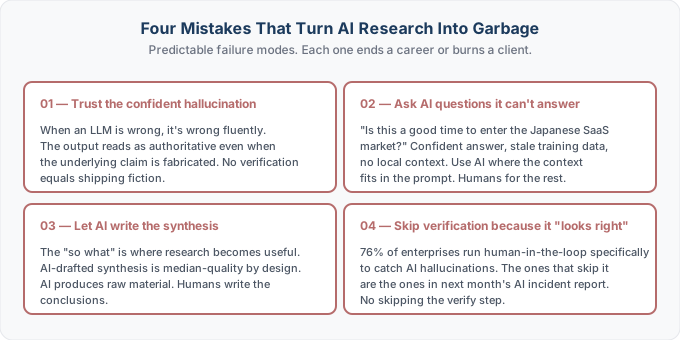
Trusting the confident hallucination. When an LLM is wrong, it’s wrong fluently. The output reads as authoritative even when the underlying claim is fabricated. If every claim in your research doesn’t have a verified primary source, you’re shipping fiction.
Using AI for tasks that need context AI doesn’t have. Asking an LLM “is this a good time to enter the Japanese SaaS market?” produces a confident answer built on stale training data and no understanding of recent policy shifts, exchange rate moves, or local competitive dynamics. Use AI where the context fits in the prompt. Use humans where it doesn’t.
Letting AI write the synthesis. The synthesis (the “so what”) is where research becomes useful. Letting AI draft it produces median-quality recommendations. Use AI to produce the raw material. Write the conclusions yourself.
Skipping verification because the output “looks right.” Industry surveys in 2026 find that most enterprises now run some form of human-in-the-loop review on AI output before it ships externally, and roughly three in four organizations report active concern about hallucinations in their deployments. The ones that skip the verification step are the ones showing up in enterprise AI incident reports. If you’re not verifying, you’re eventually going to ship something wrong.
Frequently asked questions
Will AI replace market research analysts?
No. AI replaces the mechanical parts of research: desk volume, first-pass summarization, clustering unstructured text. It doesn’t replace the judgment, scope-setting, and source verification that make research defensible. But AI will replace any market research analyst who doesn’t learn to use it. The productivity gap between a researcher using AI well and one who isn’t is roughly 3-5x on most tasks in 2026.
Will AI replace consultants?
Same answer, sharper stakes. Consultants who position their value as “I know how to read a lot of things fast” are in trouble. Consultants who sell scope definition, source discipline, and synthesis (the parts AI breaks on) are fine. The question for any advisor isn’t whether AI threatens them. It’s whether the part of their work that survives AI is also the part clients are willing to pay for.
What’s the most accurate AI tool for market research?
Model generations shift quickly, so treat any ranking as provisional. As of 2026: for source-cited research with inline references, Perplexity Pro. For complex reasoning and long document analysis, the Claude Sonnet / Opus 4.x line. For ideation and drafting, GPT-5. The best workflow uses all three for different parts of the task, not one for everything.
Can AI do market sizing on its own?
Partially. AI can pull top-down estimates from industry reports and produce bottom-up estimates from unit economics. It cannot reliably triangulate between the two or catch when an input is fabricated. Market sizing needs the triangulation method, where top-down and bottom-up numbers get reconciled and a human interprets the delta. AI accelerates the inputs. Humans validate the output.
How do I know if my AI-assisted research is actually good?
Two tests. First: can you trace every factual claim in the document to a named primary source that exists and says what you claim it says? If not, you have hallucinated content. Second: does the document make a specific recommendation with specific evidence, or does it summarize findings without taking a position? If it’s the second, the AI wrote it and you didn’t add the value.
Dossier Intel builds board-ready research dossiers that combine AI-assisted research with verified methodology. Three tiers from $197 Quick Briefs to $997 Deep Dives. See our research packages →