Bottom line: Commercial due diligence validates whether a target company’s growth thesis holds up against market reality, across five pillars — market, customer, competitive, product/pricing, and operational. Most CDD reports miss three failure patterns that quietly kill deals after close: customer concentration that hides as diversity, pricing power that doesn’t survive macro shifts, and competitive moats that aren’t moats.
Financial due diligence tells you where a company has been. Commercial due diligence tells you whether the investment thesis behind a deal actually holds up against market reality. The first one validates the past. The second one underwrites the future. Most buyers running a process treat them as equally important and budget accordingly. The deals that fail two years after close almost always failed at the commercial diligence step, not the financial one.
This is a field guide for buyers running commercial due diligence in 2026. It’s written for the audiences less well served by the existing literature: corporate development teams running tuck-ins, family offices and search funds writing first or second checks, fractional CXOs evaluating acquisitions on behalf of operating companies, and PE deal teams below the mega-fund tier who can’t drop $500K on a Big Four CDD engagement for every target.
What commercial due diligence actually answers
Commercial due diligence is the process of independently validating that a target company can deliver on its growth narrative inside the market it operates in. It runs after a letter of intent is signed, in parallel with financial and legal diligence, and it answers a different question than either of them.
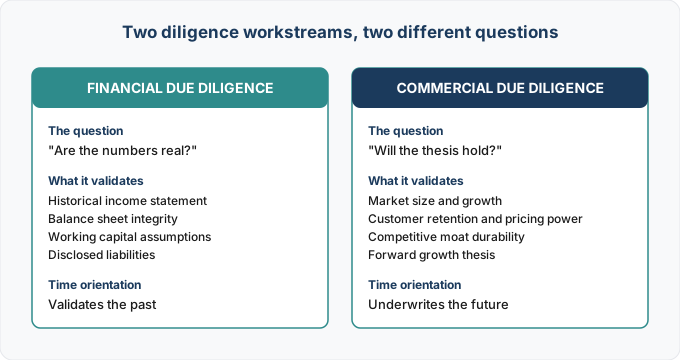
Financial due diligence validates the income statement and balance sheet. It asks: are the numbers real, are the liabilities disclosed, do the working-capital assumptions hold? Commercial diligence asks: given those numbers are real, is the market large enough, the position defensible enough, and the customer base loyal enough that the next five years of projected growth is plausible?
The five questions a competent commercial due diligence engagement answers:
- Is the addressable market real and growing? Total addressable market, serviceable addressable market, and serviceable obtainable market sized from primary sources, not company-supplied projections.
- Does the company actually own the position management claims? Market share validated against independent customer surveys and competitor revenue triangulation, not management decks.
- Will the customers stay? Net revenue retention, churn cohorts, switching cost analysis, and contractual renewal mechanics tested through independent customer interviews.
- Is the competitive moat real? Moat claims tested against competitor product reviews, win/loss analysis, and customer-stated alternatives.
- What kills the thesis? Named risks ranked by probability and material impact within the hold period.
These questions don’t change based on deal size. The depth at which each is answered does. A mid-market CDD engagement might run 15 customer interviews and 5 competitor product audits. A mega-fund engagement might run 60 customer interviews, 20 expert calls, and a custom buyer survey. The framework is the same. The sample sizes scale with budget.
The five pillars of commercial due diligence
The five-pillar framing below is adapted from public practitioner guidance (Martec Group, PwC, ICAEW) rather than copied from any single firm’s named pillars. The labels vary across consulting practices, but the underlying scope is consistent: market, customer, competitive, product/pricing, and operational analysis. The framework has held up through the recent push to integrate AI tooling into the diligence workstream because the questions each pillar asks haven’t changed.
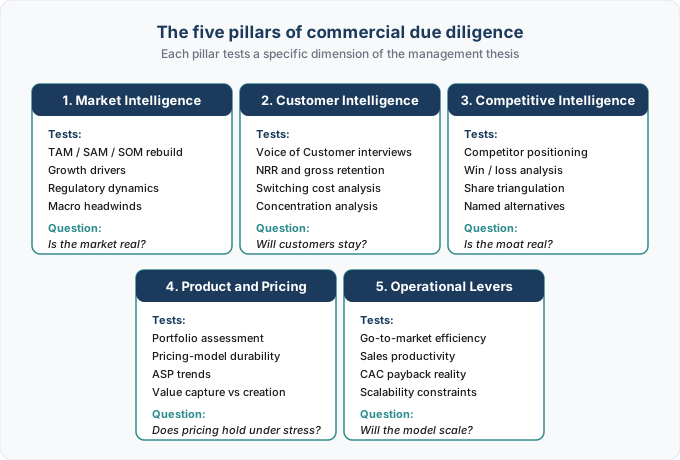
Market Intelligence. Sizing and forecasting the total addressable market, serviceable addressable market, and serviceable obtainable market, plus growth drivers, regulatory dynamics, and macro headwinds. The most common failure here is accepting management’s TAM and writing a sentence around it. A defensible CDD report rebuilds the TAM from scratch using independent sources, then explains the variance from management’s number. If the variance is large, that variance is itself a finding.
Customer Intelligence. Voice of Customer research with the target’s actual customers and a control sample of customers who chose competitors or churned. Net revenue retention, gross retention, customer concentration, switching cost analysis, and the durability of the value proposition. The methodological non-negotiable is independent recruitment: the target company cannot select which customers get interviewed, because if they do the entire study is selection-biased before the first conversation.
Competitive Intelligence. Competitor positioning, win/loss analysis, market share triangulation, and the actual basis on which deals get won and lost. The temptation in this pillar is to cite Gartner Magic Quadrants and call it done. The work that produces real findings is competitor product audits, win/loss interviews with prospects who chose alternatives, and channel checks with industry insiders.
Product and Pricing. Portfolio assessment, pricing power testing, and the durability of the company’s pricing model under macro pressure. This is where most consumer and B2B SaaS deals quietly come apart in years two and three after close. A pricing model that worked at 8% inflation may not survive at 3% if the customer base is large enterprises with annual procurement reviews.
Operational Levers. Go-to-market efficiency, sales productivity, and the operational scalability of the growth model. This pillar overlaps with operational due diligence and is sometimes scoped separately, but the commercial implication of a CAC payback period that is actually 28 months instead of the 14 months management claims is a commercial finding, not an operational one.
A practical commercial due diligence framework asks each pillar one binary question: does the evidence support what management claims, or doesn’t it? Most middle-of-the-road CDD reports fudge this with hedged language. Strong CDD reports give a clean answer per pillar and explain what would have to be true for the answer to flip.
Where most commercial due diligence reports fail
Three patterns show up disproportionately in deals that close at the modeled price and underperform within 24 months. They appear in the published post-mortem literature on failed acquisitions and in the reports PE limited partners share among themselves. Standard CDD checklists and framework decks miss them.
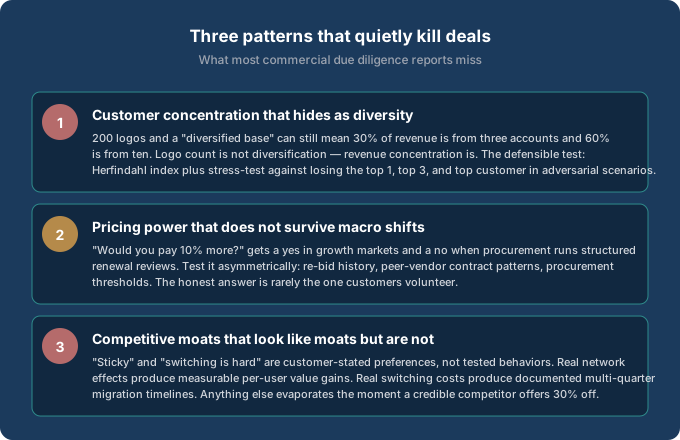
Failure pattern 1: customer concentration that hides as diversity. A target reports 200 enterprise logos and the CDD report dutifully concludes the customer base is diversified. Then the CDD report buries the line that says 30% of revenue comes from the top three accounts and 60% comes from the top ten. Logo count is not diversification. Revenue concentration is. The deals that blow up here are the ones where one of the top three accounts was already in a renegotiation cycle the seller knew about and didn’t disclose, or where the top two accounts are part of the same parent organization and only count as separate logos due to a billing technicality.
The defensible version of this pillar reports the revenue concentration ratio (top-1, top-3, and top-10 customer share) and stress-tests the model against losing the top customer, the top three customers, and the top customer in the most adversarial macro scenario the buyer can defensibly construct.
Failure pattern 2: pricing power that doesn’t survive macro shifts. Pricing power gets tested by asking customers if they would pay 10% more. They almost always say yes when the test happens during a growth market, because procurement isn’t paying attention to a 10% increase on a non-essential vendor. The same answer evaporates when the macro environment shifts and procurement runs structured renewal reviews on every contract above $25K.
The right way to test pricing power is to test it asymmetrically. Ask customers what they would do if a competitor offered 30% off. Ask whether the contract has been re-bid in the last 24 months. Ask whether the customer’s procurement function has structured renewal thresholds. Ask the customer’s recent contract history with peer vendors. The honest answer about pricing power is rarely the one customers volunteer; it’s the one their procurement behavior reveals.
Failure pattern 3: competitive moats that look like moats but aren’t. This is the most expensive failure, and it shows up in the deals where the post-close growth slows by 600+ basis points within 18 months. A target claims network effects, switching costs, and a brand premium. The CDD report cites the customer interviews where customers say the product is “sticky” and concludes the moat is real. Two years later, half the customer base has piloted a competitor at significantly lower price points and a quarter has migrated.
The test for a real moat is what customers actually do when offered a credible alternative, not what they say in an interview when no alternative is on the table. Real network effects produce measurable per-user value increases as the network grows. Real switching costs produce documented multi-quarter migration timelines for customers who have left. Real brand premium produces willingness to pay above feature-parity competitors at a delta wider than any competitor’s promotional discount window. Anything else is a customer-stated preference that hasn’t been tested, and customer-stated preferences don’t survive contact with procurement.
The commercial due diligence engagements that catch these failures are the ones that budget time for adversarial scenario testing and stress-testing customer interviews, not just confirmatory ones.
How to run the customer-interview component
Customer interviews are the single highest-signal component of a commercial due diligence engagement, and they are also the component most likely to be done badly. The methodology that separates competent customer interviewing from check-the-box customer interviewing is not exotic, but it requires discipline that most engagements skip under timeline pressure.
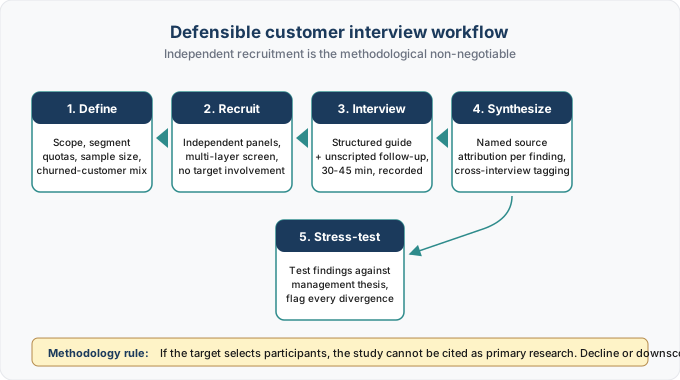
Stage 1: define scope and segment quotas. Decide upfront how many interviews are needed to produce findings that a buyer would actually act on. The benchmark from established practice is 15-30 customer interviews for a mid-market deal and 30-60 for a larger one. Inside that target, set quotas: a third with current top-decile customers, a third with current mid-tier customers, and a third with churned customers and customers who chose a competitor. The third bucket is the one most engagements skip because it’s the hardest to recruit. It is also where the highest-value findings come from.
Stage 2: independent recruitment. This is the methodological non-negotiable. The target company cannot select participants, recruit them, or even know which specific customers were interviewed. Independent recruitment means sourcing through specialist panels, screening every participant against multi-layer verification (employment at a customer company, decision-making authority over the relevant purchase, recency of interaction with the target’s product), and confirming through public LinkedIn or corporate-records cross-check.
If the target insists on selecting interviewees, the right response is to either decline the engagement, reduce the scope to expert-network calls only, or accept the engagement with a written caveat that customer-selected interviews produce confirmatory findings and cannot test the thesis. They also cannot be cited as primary research in the final report.
Stage 3: interview execution. Use a structured discussion guide so findings are comparable across interviews, but train interviewers to depart from it whenever a customer says something unexpected. The most valuable insights in primary research come from unscripted follow-ups driven by interviewer domain expertise. A junior consultant reading the guide verbatim produces 30% of the value of a senior consultant who knows when to ignore the next question and chase a tangent. Sessions run 30-45 minutes, recorded with consent, transcribed, and tagged for synthesis.
Stage 4: synthesis with named attribution. Every finding in the final report should trace to a specific interview or set of interviews. “Customers report” is not a finding. “Three of five customers in the manufacturing segment report” is. The synthesis layer is where pattern recognition across interviews has to happen, and it’s also where bias creeps in if the synthesis team is the same team that recruited and interviewed.
Stage 5: stress-test findings against the thesis. Take each pillar of the management thesis and ask: what would I have to see in the customer interviews to invalidate this? Then check whether the interviews showed it. If the management thesis says customers are sticky because of integration depth and the interviews show three of fifteen customers running active proof-of-concepts with a competitor, the thesis isn’t invalidated yet but it’s flagged. The deals that close on incomplete commercial diligence are the ones where flags like this got softened in the executive summary.
What a commercial due diligence report actually contains
The commercial due diligence report is the deliverable. Everything before it is process. Buyers commissioning CDD have a reasonable expectation about what arrives in the data room at the end, and the structure has converged across buy-side and vendor-side engagements.
A standard commercial due diligence report runs 40-80 pages plus appendices, depending on deal size. It includes:
| Section | Typical length | What it covers |
|---|---|---|
| Executive summary | 2-3 pages | Headline findings, recommendation, three to five key risks ranked by materiality |
| Market analysis | 8-15 pages | TAM/SAM/SOM rebuild, growth drivers, regulatory dynamics, macro headwinds |
| Competitive landscape | 6-12 pages | Competitor positioning, win/loss analysis, share triangulation, named alternatives |
| Customer analysis | 10-15 pages | Voice of Customer findings, retention cohorts, concentration analysis, pricing power |
| Product and pricing | 4-8 pages | Portfolio assessment, pricing-model durability, ASP trends |
| Operational and growth levers | 4-8 pages | GTM efficiency, sales productivity, scalability constraints |
| Risk register | 3-5 pages | Named risks ranked by probability and impact, with the test for each |
| Source trail | 5-10 pages | Every cited source with publication date, URL, and access timestamp |
| Methodology appendix | 3-5 pages | Interview counts, panel sources, quotas met, screening criteria, exclusions |
Cost for a third-party CDD engagement runs $25K-$50K for small-cap deals under $10M, $50K-$150K for mid-market deals between $10M and $100M, $150K-$500K for deals between $100M and $1B, and $500K+ for mega deals. Timeline pressure adds a 20-40% premium for accelerated engagements. The unbundled-research model that has gained traction since 2024 (sourcing the primary-research component directly rather than paying a consulting firm to subcontract it) often produces equivalent quality at 40-60% of the all-in consulting fee.
Some buyers run an internal commercial diligence process and bring in third-party support only for the customer-interview component. Others run the entire workstream externally. The choice is usually less about cost and more about whether the buyer has internal team capacity to absorb the synthesis workload during a deal sprint. If you’re scoping internal capacity, our DD scorecard tool provides a framework for estimating diligence depth across the standard pillars before you commit to an engagement structure.
The 2026 context — why CDD changed
Three shifts have changed the shape of commercial due diligence engagements over the last 24 months, and any buyer scoping a CDD process now needs to account for them.
Private equity has moved from growth-at-any-cost to operational value creation. The era of pricing in 30%+ revenue CAGRs and counting on multiple expansion to drive returns is over. PE firms are underwriting deals on operational improvement, sector specialization, and data-enabled transformation, which means commercial diligence has to test whether those operational levers actually exist at the target. The 2026 PE outlook reports from EY, BDO, and Cherry Bekaert all flag the same theme: lengthier and more granular due diligence is now the norm, and buyers are justifying premium prices by demonstrating that projected cash flows and strategic advantages truly support the multiple.
The commercial due diligence market itself is growing. Estimates vary by provider: Business Research Insights projects the global CDD market reaching $2.51B in 2026 and growing at 7.8% CAGR through 2035, while other published forecasts run higher (13-14% CAGR through 2033). The direction is consistent across estimates even when the rate disagrees. The growth is driven by deeper diligence requirements, the unbundling of primary research from full-stack strategy consulting, and the entrance of mid-market buyers who previously skipped formal CDD entirely.
AI is changing the workstream more than the deliverable. Firms are now expanding commercial diligence to explicitly assess AI-driven industry disruption: how AI may reshape competitive dynamics, pricing models, and barriers to entry within the target’s market. Inside the workstream, AI tools are accelerating desk research, automating transcript synthesis, and enabling faster competitor product audits. They are not replacing the customer-interview component, the pricing-power stress tests, or the moat analysis. The judgment work is still human work, and the deliverable still depends on whether the human asking the questions knows what to ask.
For buyers running their first formal CDD engagement, the 2026 context produces one practical implication: budget more time and slightly more money than the deals you saw closed in 2022 would suggest, and apply more weight to the customer-interview component. The deals that have outperformed in the current cycle are the ones where the customer-interview workstream caught failure pattern two or three before close. The deals that have underperformed are the ones where it didn’t.
Frequently asked questions
What’s the difference between commercial due diligence and financial due diligence?
Financial due diligence validates the historical income statement and balance sheet. Commercial due diligence validates whether the forward-looking growth thesis holds against market reality. Financial answers “are the numbers real?” Commercial answers “will the numbers continue?” Both are needed for any meaningful M&A transaction; neither substitutes for the other.
How long does commercial due diligence take?
A standard mid-market commercial due diligence engagement runs 4-6 weeks. Accelerated engagements compress to 2-3 weeks at a 20-40% cost premium. Mega-deal CDD can run 8-12 weeks if customer-interview sample sizes exceed 60. The bottleneck is usually customer recruitment, which is why aggressive timelines tend to compromise the customer-interview component first.
How much does commercial due diligence cost?
Cost scales with deal size: $25K-$50K for deals under $10M, $50K-$150K for mid-market deals between $10M and $100M, and $150K-$500K for deals between $100M and $1B. Mega deals over $1B regularly exceed $500K. Unbundled primary research alone runs 40-60% of the equivalent full-stack consulting engagement. Timeline pressure adds 20-40%.
Can commercial due diligence be conducted remotely?
Yes, and most engagements have been remote-first since 2021. Customer interviews run by video, expert calls run by phone, and competitor product audits run on commercial accounts purchased independently. Site visits to the target’s facilities still happen for operational due diligence, but the commercial workstream is structurally remote-friendly. The methodological standards are the same regardless of format.
When you need a Deep Dive
For buyers who would rather outsource the workstream than build it internally, a formal commercial due diligence engagement is the canonical use case for a Deep Dive research deliverable: 30-50 pages, full source trail, customer-interview synthesis, competitive landscape, and a named risk register. We run these for fractional executives, search funds, family offices, and corporate development teams who need consulting-firm-quality output without the consulting-firm price tag or timeline.
The Deep Dive package covers all five pillars with the methodological discipline outlined above, delivered in 7-10 business days for $997. If you’re running a process and need commercial diligence depth without committing to a $150K+ Big Four engagement, start with our Deep Dive service or run our DD scorecard to estimate where your internal capacity ends and where external support is worth budgeting for.
For broader context on how due diligence frameworks fit together, see our due diligence checklist guide and our company profiling guide, which cover the adjacent workstreams that commercial diligence draws from.