You have a meeting in four days with a company you know almost nothing about. Could be a fractional CFO evaluating a potential client, or an investor running initial screens on a deal. Either way, the clock is ticking and the “About Us” page is not going to cut it.
You need a company profile that tells you how the business makes money, who it competes with, where the risks are, and what questions you should be asking in that meeting.
Most people start with Google and end up with a pile of disconnected tabs. Company profiling done well is more structured than that, and the difference between a scattered hour on the internet and a focused 30-minute research process comes down to knowing what to look for and where to find it.
What company profiling actually means
Search “company profiling” and most results tell you how to write a company profile for your own business. That is a marketing exercise. What we are talking about is the opposite: researching someone else’s company to inform a decision.
Company profiling as a research discipline means building a structured view of an organization using publicly available data, proprietary databases, and good judgment about what matters. The output is a decision document, not a brochure.
The people who do this well, analysts and experienced consultants mostly, follow a consistent framework. They do not start from scratch every time because they already know what categories of information matter and where to find them.
The six categories of a useful company profile
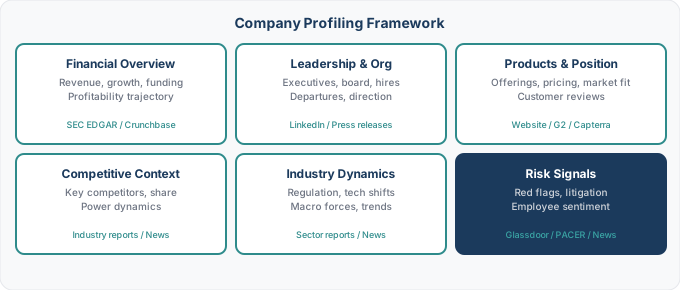
A company profile that informs decisions covers six areas. You will not always need all six at full depth, but skipping any of them entirely leaves a blind spot.
Financial overview
Revenue, profitability, growth trajectory, and funding history. For public companies this is straightforward from SEC filings and earnings reports. For private companies you are working with estimates from databases like PitchBook, Crunchbase, or industry-specific sources.
The question is not just “how big are they” but “where is the money coming from and is it growing.” A $50 million company growing at 3% tells a very different story than a $15 million company growing at 40%.
Leadership and organizational structure
Who runs the company and what is their background. LinkedIn is the obvious starting point, but board composition, recent executive hires, and departures tell you more about strategic direction than any press release.
A company that just hired a new VP of International Sales is probably planning to expand geographically. A company whose CFO left after 18 months might have financial issues that have not hit the news yet. Reading the org chart is a skill.
Products, services, and market position
What they sell, who they sell it to, and how they position themselves against alternatives. This is where competitor profiling overlaps with company profiling. You can not understand a company’s position without understanding the competitive landscape they operate in.
Look at their pricing, their messaging, their customer reviews, and their case studies. The gap between how a company describes itself and how its customers describe it is usually where the real insights are.
Competitive context
Who else plays in this space and what is the power dynamic. A company that dominates a fragmented market faces different risks than one fighting for share against two well-funded competitors.
This is the category most people shortchange. They will research the target company thoroughly but skip the competitive context entirely. That is like studying one team’s roster without knowing who they are playing against.
Industry dynamics and external forces
Regulatory environment, technology shifts, macroeconomic factors, and sector-specific trends that affect the company whether they like it or not. A company profile without industry context is a snapshot without a frame.
What external forces could materially change this company’s trajectory in the next 12 to 24 months? If you can not answer that after finishing your research, your company deep dive has a hole in it.
Risk signals
Red flags and warning signs. These do not always show up in official filings. Employee reviews on Glassdoor, litigation databases, negative news coverage, and sudden changes in hiring patterns all tell a story.
This is where company background research gets uncomfortable because you are specifically looking for problems. But that is the point. The executive who walks into a meeting already aware of the risks is the one who earns trust fastest.
Where to find the information
The sources you use depend on whether the company is public or private, and how much time you have.
| Source | What it tells you | Best for | Cost |
|---|---|---|---|
| Company website | Products, positioning, leadership bios, press releases | Starting point for any profile | Free |
| SEC EDGAR | Revenue, segments, risk factors, executive compensation | Public companies | Free |
| OpenCorporates | Incorporation details, registered agents, filing status | Verifying basics on any company | Free |
| Org structure, hiring trends, employee count changes | All companies | Free (limited) | |
| Crunchbase | Funding history, valuation, investors | Startups and private companies | Free tier available |
| PitchBook | Detailed financials, deal history, comparable companies | Investment research | Paid |
| Glassdoor / Indeed reviews | Culture, management quality, internal issues | Risk assessment | Free |
| Industry reports (IBISWorld, Statista) | Market size, growth rates, sector trends | Industry context | Paid |
| Google News / LexisNexis | Recent developments, M&A activity, leadership changes | Timely intelligence | Free / Paid |
| Patent databases (USPTO, Google Patents) | R&D direction, innovation pipeline | Tech and pharma companies | Free |
| Court records (PACER, state courts) | Legal exposure, regulatory issues | Risk assessment | Low cost |
The mistake most people make is relying on one or two sources. A company’s website tells you what they want you to know. Employee reviews tell you what they would rather you didn’t. Financial filings tell you what regulators require them to disclose. You need all of those perspectives to build a profile worth acting on.
Company profiling in 30 minutes vs. 3 days
Not every situation calls for the same depth.
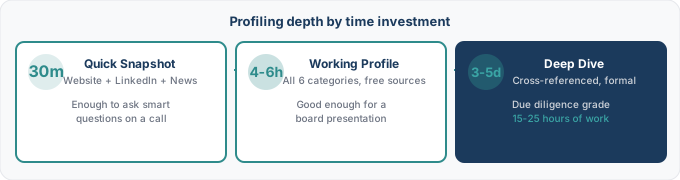
If you have 30 minutes, focus on a company snapshot. Hit the company website (About, Products, News), the CEO’s LinkedIn, one or two recent news articles, and a quick Glassdoor scan. That gets you enough to ask smart questions on a call.
If you have half a day, you can build a real company research checklist. Cover all six categories using free sources. Pull financials if the company is public, check competitive positioning, scan for risk signals. This produces a working profile you can present from.
If you have multiple days, you are doing a proper company deep dive. Think due diligence for an investment, acquisition, or major engagement. Structured analysis across all six categories with multiple sources cross referenced. The output is a formal document with findings, implications, and recommendations. This kind of research typically takes 15 to 25 hours of focused work. It is also the kind of work worth outsourcing to someone who does it every day, rather than pulling an executive off billable work for a week. This is the kind of analysis included in every Standard Dossier we deliver.
Common mistakes that weaken a company profile
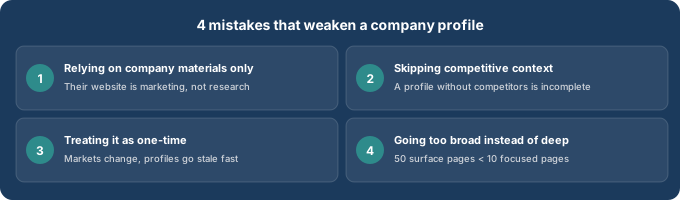
After reviewing hundreds of company profiles, the same mistakes show up repeatedly.
The first is relying entirely on the company’s own materials. Their website is marketing. Their investor deck is marketing with numbers attached. Use these as inputs, not conclusions.
The second is skipping competitive context. A company profile without competitors is a resume without references. You can not assess strengths and weaknesses without knowing who they are up against.
Third, treating it as a one-time exercise. Markets move. Companies change. A profile from six months ago might be materially wrong today. Build in a refresh cycle, or at least flag the date prominently so readers know what they are working with.
And finally, going too broad instead of too deep. A 50-page profile that covers everything at surface level is less useful than a 10-page one that goes deep on the three things that matter for your specific decision. Know your use case before you start researching.
Frequently asked questions
How long does it take to build a useful company profile? A basic profile takes 30 to 60 minutes using free sources. A thorough profile covering all six categories takes a full day. A due diligence grade company deep dive with cross referenced sources takes 3 to 5 days of focused research work.
What is the difference between company profiling and competitor profiling? Company profiling focuses on one organization in depth. Competitor profiling maps multiple companies against each other to understand relative positioning. They overlap but serve different purposes. A company profile tells you about one player. A competitive analysis tells you about the game.
Can AI tools replace manual company profiling? AI speeds up data collection significantly, but it has real limitations for this kind of work. A Virginia Tech study found bias in 83% of AI models tested, and hallucinated sources remain a persistent problem. AI can not access proprietary databases, assess source quality, or synthesize findings for your specific decision. The best approach combines AI tools with human judgment. That is how we build every dossier we deliver.
What should I do if the company is private and data is limited? Start with OpenCorporates for incorporation details (it covers 200 million+ companies globally), then LinkedIn for org structure and hiring trends, Crunchbase for funding history, and employee reviews for culture signals. Private companies require more inference from indirect sources. Job postings and headcount changes can signal growth or contraction even when financials are not available.
What free tools can I use for company profiling? SEC EDGAR for public company filings, OpenCorporates for basic registration data, LinkedIn for org structure, Google Patents for R&D activity, and PACER for federal court records. Crunchbase offers a free tier with limited data on startups. For a more complete picture you will typically need paid sources like PitchBook or industry-specific databases.
If company profiling is part of a broader competitive or due diligence effort, our free competitor analysis template covers the full six-category framework for mapping multiple companies against each other.
Dossier Intel builds company profiles and research dossiers for executives who need to walk in prepared. Our Standard Dossier covers all six profiling categories with cross referenced sources, delivered in 3 to 5 business days. See our research packages →